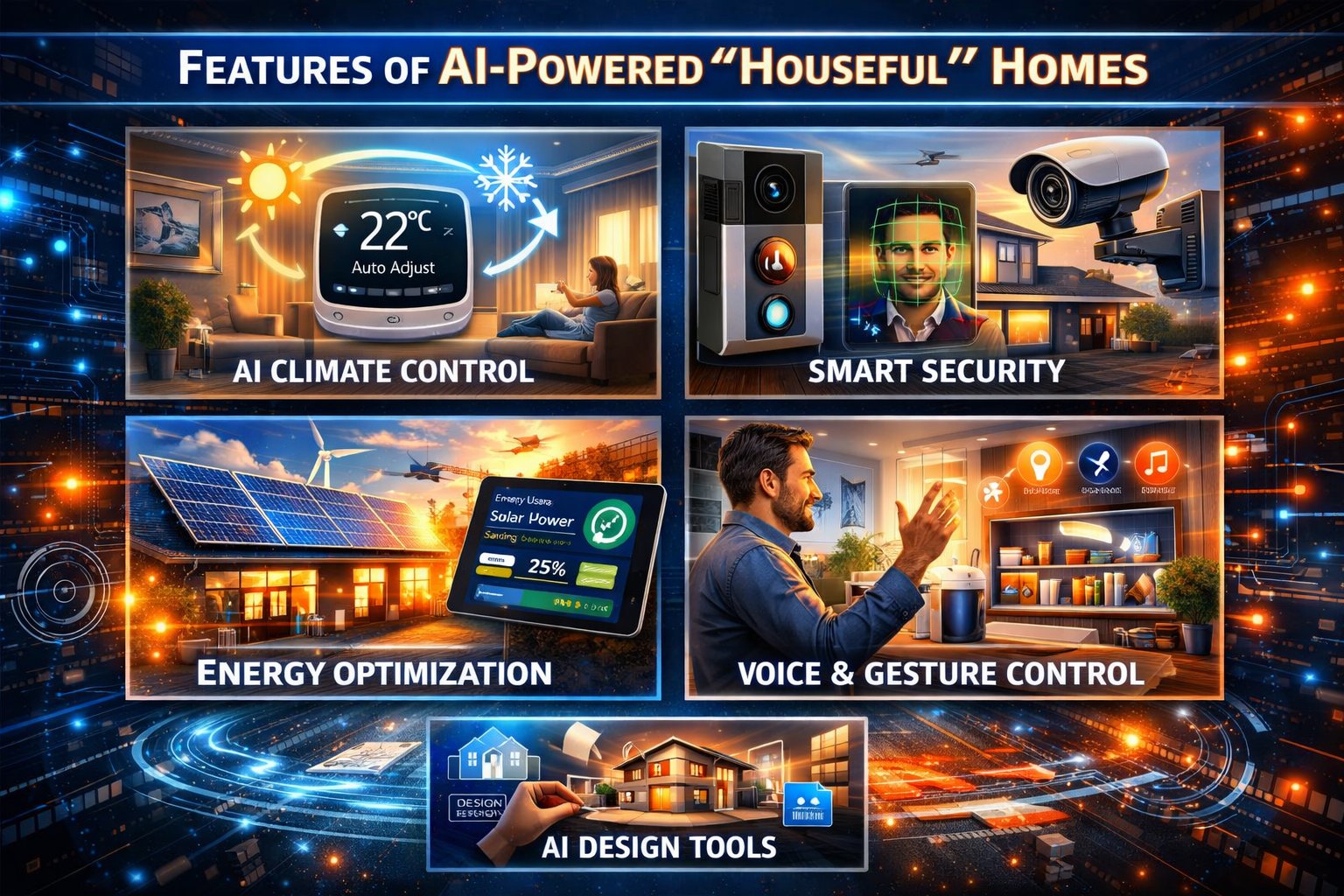
A new wave of AI-powered homes—dubbed “houseful” smart residences—is emerging across Bahrain and globally, blending automation, sustainability, and intelligent living. These homes integrate AI for energy efficiency, security, and personalized comfort, with platforms like VEED and AI architecture generators enabling rapid design and visualization.
🏠 What Is a “Houseful” AI Home?
The term “houseful” in the AI context refers to homes that are fully equipped with artificial intelligence systems across multiple domains—security, climate control, entertainment, and energy management. These homes are designed to be:
- Fully automated with voice and gesture control
- Self-learning through behavioral data
- Connected to smart grids and IoT ecosystems
- Customizable via AI-powered design platforms like VEED and Scenario Changer
🔧 Key Features of AI-Powered “Houseful” Homes
| Feature | Description |
|---|---|
| AI Climate Control | Adjusts temperature and humidity based on preferences and weather forecasts |
| Smart Security | Facial recognition, motion detection, and predictive alerts |
| Energy Optimization | AI monitors usage and suggests savings via solar or smart grid integration |
| Voice & Gesture Interfaces | Control lighting, appliances, and media hands-free |
| AI Design Tools | Platforms like VEED allow users to generate house visuals from text prompts |
These homes are often built with modular architecture and can be visualized or remodeled using AI generators before construction begins.
🌍 Adoption in Bahrain and Beyond
In Bahrain, AI-driven home design is gaining traction among developers and tech-savvy buyers. With rising interest in sustainable living, many new homes include:
- Solar panel integration
- AI-based water usage tracking
- Remote diagnostics for appliances
Globally, countries like the UAE, Singapore, and South Korea are leading in smart home adoption, with AI embedded in urban planning and residential infrastructure.
⚠️ Risks and Considerations
While AI homes offer convenience, they also raise concerns:
- Privacy: Continuous data collection may expose personal habits.
- Security: Smart systems are vulnerable to hacking if not properly secured.
- Cost: Initial setup and maintenance can be expensive.
- Over-reliance: Users may lose manual control or critical thinking in emergencies.
To mitigate these risks, experts recommend local data storage, multi-factor authentication, and manual override systems.
🛠️ How to Build or Buy a “Houseful” AI Home
- Define your needs: Security, energy, entertainment, or all-in-one?
- Choose a platform: Use AI house generators like VEED to visualize your design.
- Consult smart home integrators: Look for certified AI architects or builders.
- Ensure compatibility: Devices should support common protocols (Zigbee, Matter, Wi-Fi 6).
- Plan for updates: AI systems evolve—ensure your home can adapt.