Here’s a complete, well-structured article on AI & Automation, with all the essential components you’d expect in a professional piece:
AI & Automation: Transforming the Future of Work
Introduction
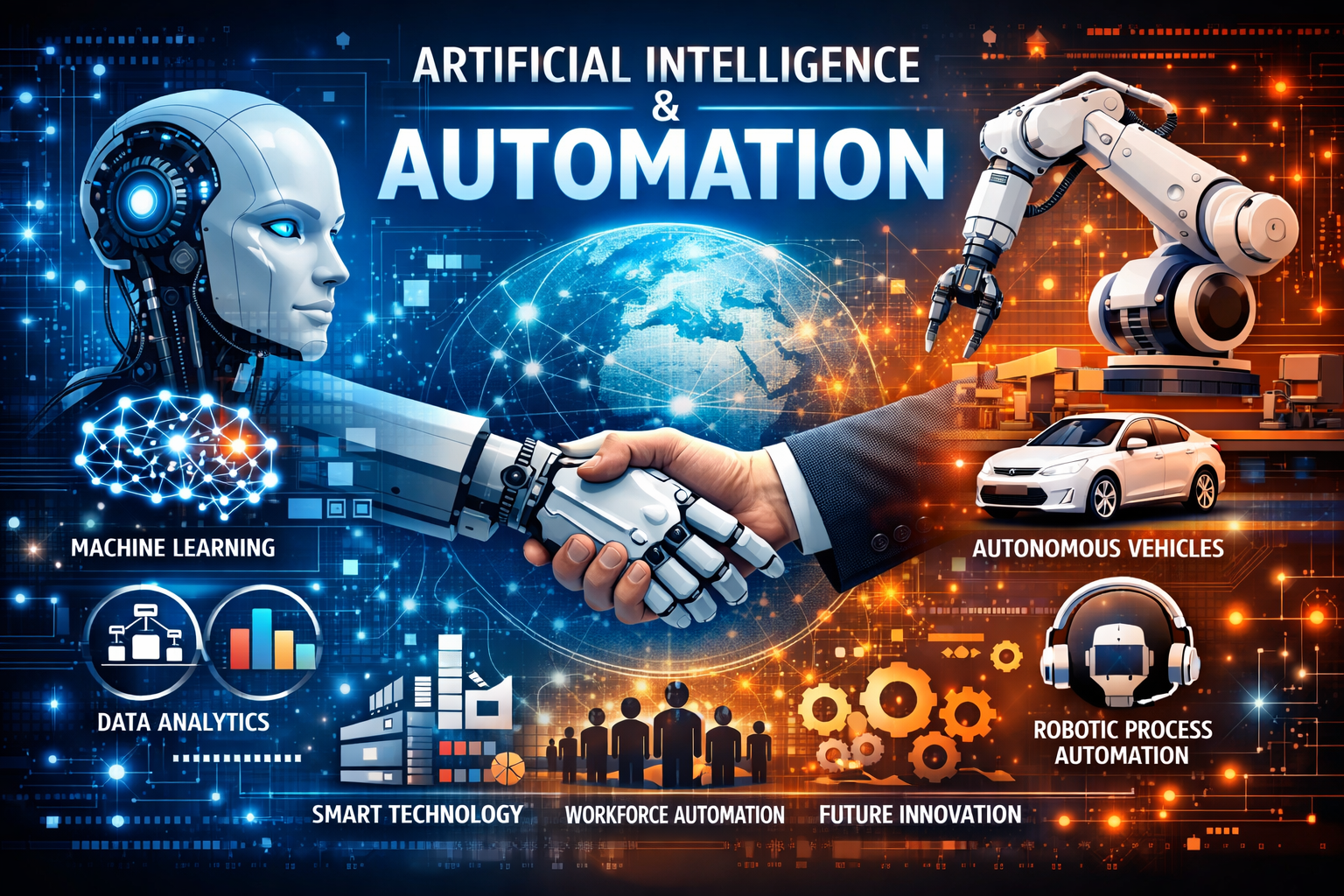
Artificial Intelligence (AI) and automation are no longer futuristic concepts—they are reshaping industries, redefining productivity, and transforming the way humans interact with technology. From smart assistants to autonomous vehicles, these innovations are driving efficiency while raising important questions about ethics, employment, and human creativity.
What is AI & Automation?
- Artificial Intelligence (AI): The simulation of human intelligence in machines, enabling them to learn, reason, and make decisions.
- Automation: The use of technology to perform tasks with minimal human intervention, often streamlining repetitive or complex processes.
Together, AI-powered automation combines machine learning, robotics, and data analytics to create systems that can adapt and improve over time.
Key Applications
| Sector | AI & Automation Impact |
|---|---|
| 🌐 Healthcare | AI diagnostics, robotic surgeries, predictive analytics |
| 🏭 Manufacturing | Smart factories, robotic assembly lines, predictive maintenance |
| 📊 Business | Automated customer service, fraud detection, workflow optimization |
| 🚗 Transportation | Self-driving cars, traffic management, logistics automation |
| 🏠 Everyday Life | Smart homes, voice assistants, personalized recommendations |
Benefits
- Efficiency: Faster, more accurate task completion.
- Cost Reduction: Lower operational expenses through automation.
- Scalability: Systems can handle massive workloads without fatigue.
- Innovation: Frees humans to focus on creative and strategic work.
Challenges
- Job Displacement: Automation may replace certain roles, requiring reskilling.
- Ethical Concerns: Bias in AI algorithms and decision-making transparency.
- Security Risks: Automated systems vulnerable to cyberattacks.
- Human Dependency: Over-reliance on machines could reduce critical thinking.
Future Outlook
AI and automation are expected to evolve into hyper-automation, where multiple technologies integrate seamlessly to create fully autonomous systems. The future will likely see:
- Collaborative robots (“cobots”) working alongside humans.
- AI-driven decision-making in governance and policy.
- Personalized automation in education and healthcare.
Conclusion
AI and automation are powerful tools that can revolutionize industries and daily life. While they bring immense opportunities, they also demand careful consideration of ethics, workforce adaptation, and security. The future of work will not be about humans versus machines, but about humans and machines working together to build smarter, more inclusive societies.